

Industry programme IPCS
Satellite Symposium
This independent in-person Satellite Symposium will be held in the Convention Centre Room B1 and live streamed.
The recording will be available on-demand for registered participants after the Conference until December 2026 (unless otherwise requested by the organising Company).
The Satellite Symposium is open to all registered participants.
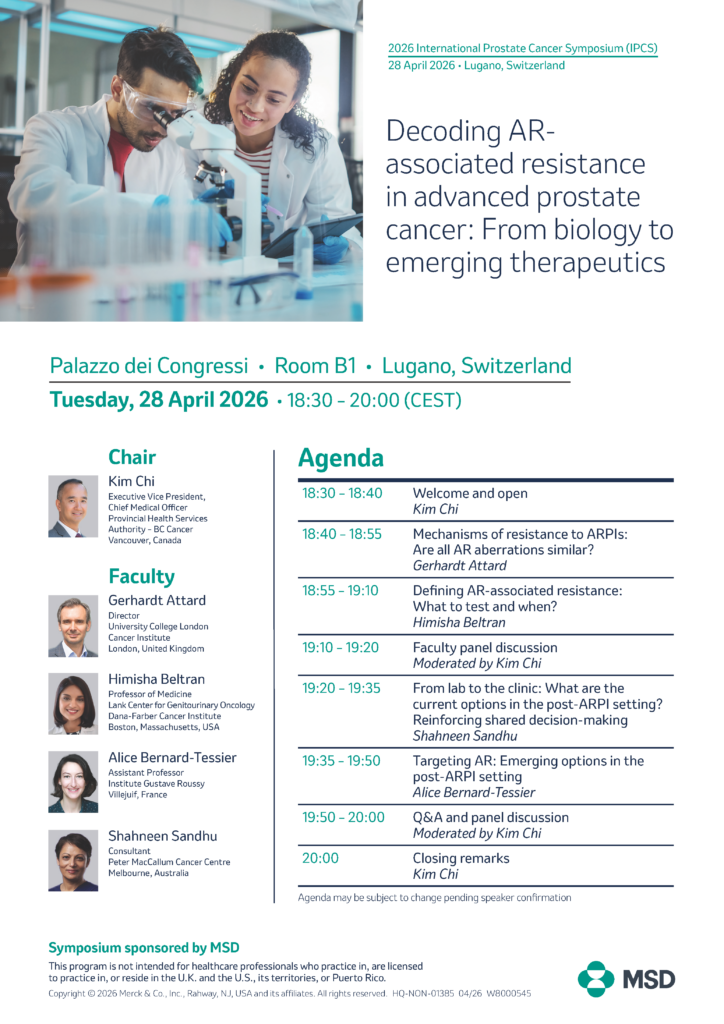
MSD Satellite Symposium
Tuesday 28 April 2026
18:30–20:00
Room B1 – 1st Floor – Convention Centre, Lugano
Thematic Innovative Talks
Wednesday 29 April 2026
17:30–18:30
Room B1 – 1st Floor – Convention Centre, Lugano
These three presentations of innovative biotech companies are selected by the IPCS scientific committee.
The recording will be available on-demand for registered participants after the Conference until December 2026 (unless otherwise requested by company).
The Thematic Innovative Talks are open to all registered participants.
17:30-17:50 BioNTech
At BioNTech, prostate cancer is a key strategic focus within our broader ambition to redefine the future of cancer care across multiple tumor types. We are building a therapeutic pipeline designed to move beyond incremental progress and address areas of profound unmet need through novel modalities and differentiated mechanisms, such as our B7H3 antibody–drug conjugate and our anti–CTLA-4 antibody. In prostate cancer, our ambition is to deliver highly effective and more tolerable treatment options by advancing innovative approaches along the disease continuum. Rigorous clinical trials, together with deep collaboration across the medical community, are fundamental to realizing this mission.
17:50–18:10 Translational Medicine, Genentech
Current endpoints used for early decision-making in mCRPC, including PSA50 and ORR, have important limitations in predicting durable clinical benefit. Emerging data from our group and others demonstrate that ctDNA clearance provides a more direct assessment of tumor biology and may better capture residual disease and treatment response. Integrating ctDNA clearance with clinical endpoints could improve patient selection and enable earlier, more informed decisions. To advance this field, there is a need for collaborative, cross-industry efforts to systematically evaluate ctDNA dynamics, define clinically meaningful thresholds, and establish standardized benchmarks across therapeutic modalities, ultimately enabling more biology-driven development and accelerating delivery of effective therapies to patients.
18:10–18:30 The Cancer Atlas Series – An Integrated and Interactive Platform for Research and Patient Care
RNA provides a dynamic, quantifiable measure of the biologically relevant output of the genome and thus represents the ideal basic framework for generating comprehensive disease atlases to understand the expression of drug targets, related biomarkers, and disease evolution. However, generating RNA atlases across studies in different disease settings is challenging because of artifacts introduced by different analysis pipelines, known as “batch effects”. We overcame these hurdles and, at the Institute of Oncology Research (IOR), produced a harmonized bulk and single-cell RNA sequencing atlas for prostate cancer. In parallel, with support from the pharma industry, we developed a professional cloud-based web tool for users to visualize and analyze atlas data in a customized manner (www.prostatecanceratlas.org, www.prostatecanceratlas.com).
Tabletop Exhibition
The IPCS Exhibition area, as Tabletop display area of max ca. 4 m2, (basic furniture one table and chairs included) is organized in Villa Ciani 2nd Floor, directly connected to Convention Centre.
An outstanding chance to display your company’s materials and engage with attendees in a historic, prestigious venue — ideal for showcasing, networking, and building new connections in an exclusive, intimate environment.
Opening hours:
Tuesday 28 April from 10:00 to 19:00
Wednesday 29 April from 08:00 to 19:00





This event is organized by the Foundation for the Institute of Oncology Research in collaboration with APC Society.


Supported by


